
Learning the letter J is a foundational literacy skill that takes most adult learners 3 to 5 practice sessions to master through a simple progression: recognition, sound connection, writing practice, and real-world application. Whether you’re an educator developing adult lesson plans or a learner building your reading skills, this letter offers a clear starting point because it appears consistently in everyday Canadian contexts like job applications, juice labels, and January calendars.
The letter J produces a single, distinct sound (as in “jump” or “jar”), which makes it easier to learn than letters with multiple pronunciations. Adult learners often connect quickly with J-words that appear in their daily lives: jobs, jeans, jam, and juice. This practical relevance helps reinforce learning beyond the classroom.
This guide walks you through everything you need to teach or learn the letter J, from gathering free materials to confirming mastery. You’ll find step-by-step instructions that respect adult learners’ time and experience, verification methods to track progress, and connections to free Canadian literacy resources. The approach is structured but flexible, allowing you to adapt the pace to individual needs while building confidence at each stage.
What You Need to Get Started with J Learning
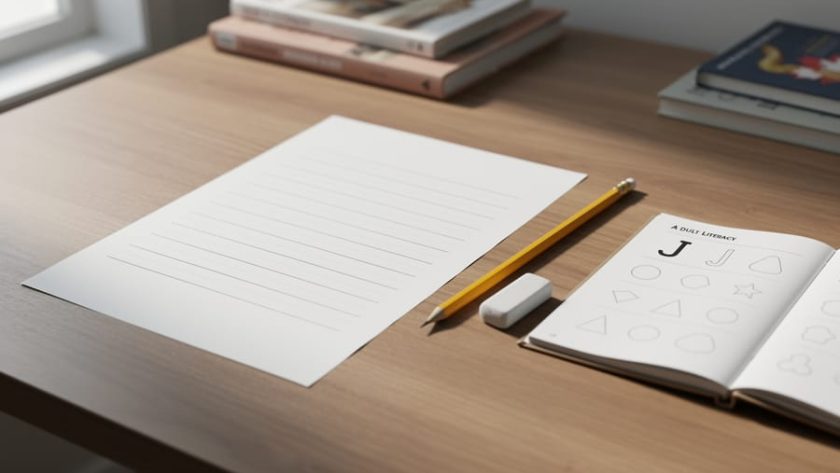
You need only a handful of simple items to begin learning the letter J. Most materials are free or cost very little, and many Canadian literacy programs offer them at no charge.
- Plain paper or lined notebook paper for writing practice
- Pencils with erasers (regular #2 pencils work well)
- Letter formation guides showing how to write uppercase J and lowercase j
- Practice worksheets with dotted letters for tracing
- A comfortable writing surface and chair at the right height
Lined paper helps you write letters at a consistent size. Start with wide-ruled paper if you find smaller lines challenging. You can get printable letter resources for adults from Canadian literacy centres and libraries without paying anything.
Optional items make practice easier but aren’t necessary. A pencil grip can help if holding a pencil feels awkward. Highlighters let you mark J letters in printed text for recognition practice. If you have internet access, free websites and apps offer letter tracing on a screen, though paper and pencil build stronger muscle memory.
Your local library often stocks beginner literacy workbooks you can borrow. Many Canadian settlement agencies and adult learning centres provide complete starter kits with all these materials. The key is having something to write with, something to write on, and a guide showing the correct letter shape. Everything else enhances practice but isn’t required to start.
Before You Begin: Important Tips for Success

Setting up the right learning environment makes J learning easier and more comfortable. Find a quiet space where you can focus without interruptions, and make sure you have good lighting so you can see the letter shapes clearly. Sit at a table or desk where you can rest your arms comfortably while writing, with your feet flat on the floor and your back supported.
Keep your practice sessions short at first. Twenty to thirty minutes is enough time to make progress without getting tired or frustrated. If you notice tension in your hand, shoulder, or neck, take a break. Learning works better when you’re relaxed and comfortable.
Create a simple workspace with just what you need: paper, pencil, and eraser within easy reach. Put away phones and turn off the TV so you can concentrate. Some adult learners find that setting a regular practice time each day helps them stay consistent. Others prefer shorter sessions spread throughout the week. Choose what fits your schedule and energy level, and remember that regular practice beats long, exhausting sessions.
Step-by-Step J Learning Process
Step 1: Recognize and Trace the Letter J
Start by looking at the uppercase J. It’s a vertical line that curves left at the bottom, like a cane or hook. The lowercase j is similar but smaller, with a dot on top. Hold a letter guide or worksheet in front of you and notice how J differs from other letters, it’s the only one that hangs below the line with that distinctive curve.
Place your pencil at the top and draw straight down, then curve gently to the left at the bottom. For lowercase j, make the same motion but remember to add the dot above after you finish the main stroke. Don’t rush this part. Tracing the letter repeatedly builds the muscle memory you need for confident writing later.
Use worksheets with dotted or dashed letters to follow the path. Keep your hand relaxed and maintain light pressure on the pencil. If the curve feels awkward at first, that’s normal, step-by-step practice will make the motion smoother. Trace at least ten times before moving to independent writing, and pay attention to where your pencil starts and stops. This foundation makes everything that follows much easier.
Step 2: Practice Writing J on Your Own
Once you can trace J comfortably, start writing it without a guide. Begin with large letters on unlined paper. Make your J about 3-4 inches tall at first. This size lets you focus on the shape and movement without worrying about staying small and precise.
Use a pencil with a good eraser. Start at the top, pull straight down, then curve left at the bottom. Lift your pencil and add the dot or small line at the top for lowercase j. For uppercase J, just make the letter bigger and skip the dot.
After ten large J’s feel natural, switch to lined paper. Primary-lined paper works well because it shows you where to start and stop. The tall line of J should touch the top line. The curve sits on the bottom line. For lowercase j, the dot floats in the space above.
Write a full line of uppercase J, then a line of lowercase j. Do this daily. Your hand will remember the motion, and the letters will become automatic. If your J looks wobbly, slow down. Speed comes with repetition, not rushing.
Keep your practice sheets. Comparing today’s J to last week’s shows real progress and builds confidence.
Step 3: Learn J Sounds and Pronunciation
Once you’re comfortable writing the letter J, it’s time to connect it to its sound. The letter J makes a “juh” sound, like the beginning of “jump” or “juice.” Say it out loud a few times: “juh, juh, juh.” Notice how your tongue touches the roof of your mouth just behind your teeth.
Practice by saying simple J words slowly: jam, jet, job, just. Emphasize the beginning sound each time. If you’re working with a learning partner, take turns saying J words and listening for that “juh” sound at the start.
Try this sound exercise: Look around your home and name objects that start with J. Can you think of jacket, jar, or jug? Say each word clearly and feel how your mouth forms the J sound. You can also use worksheet activities to match pictures with J words, reinforcing both the visual letter and its sound.
Listen for J in everyday conversations too. When you hear words like “job” or “June,” pause and recognize that J sound you’ve been practicing. This connection between seeing the letter, hearing its sound, and saying it yourself builds strong literacy skills. The more you practice pronouncing J words aloud, the more natural it becomes.

Step 4: Read and Write Simple J Words
Once you can write J confidently on your own, start working with simple words. This step connects letter practice to real reading and writing you’ll use every day.
Start with short J words that appear often in everyday life. Good beginning words include: jam, jet, job, joy, just, and jump. Write each word several times, saying it out loud as you write. This connects the letter shape to its sound in actual words.
Practice reading J words in a list first, then in simple sentences. Try sentences like “I need a job” or “Jump up and down.” Read them slowly, pointing to each word. Notice how J sounds at the start of the word.
Copy these sentences onto your own paper. Start by tracing if needed, then write them independently. Keep your letters on the lines and make sure your J sits properly below the baseline.
Build your own simple sentences using J words you’ve learned. Write about things in your life: “I like jam on toast” or “My job starts at nine.” Real sentences that matter to you are easier to remember and practice.
Keep a list of new J words you discover in books, signs, or forms. Add words like June, join, juice, or journey as you encounter them. Writing words that connect to your daily activities makes J learning practical and useful.
Step 5: Use J in Everyday Writing
The real value of learning the letter J shows up when you use it in daily life. Start by looking at places where J already appears in your world. If your name contains J (Jason, Jennifer, Jim, Judy), practice signing it on scrap paper until the J feels natural. Write it ten times, then sign a practice form or piece of mail.
Next, try writing a simple shopping list that includes J words: juice, jam, jelly, jar. Even adding one or two J items helps reinforce the letter. Keep a small notepad for lists and notes where you can practice.
Fill out practice forms using words with J. Write “job,” your “June” birthdate if applicable, or simple sentences like “I need juice.” Many library programs offer blank practice forms for this purpose.
Send a short note to someone. “Hi Jan, I hope you are well” uses J twice and makes your practice meaningful. Real-world writing, even brief messages, builds confidence faster than worksheets alone because you see immediate purpose in what you’re learning.
How to Know You’re Making Progress
Tracking your progress with J learning helps you stay motivated and know when you’re ready to move forward. Start by keeping your earliest writing samples of the letter J in a folder or notebook. Every week or two, write the letter J again and compare it to your previous attempts. You should see improvements in shape, consistency, and confidence.
Use this simple checklist to measure your success:
- You can write both uppercase J and lowercase j without looking at a guide
- Your J letters look consistent in size and shape across a page
- You recognize J immediately when you see it in words or signs
- You can say the J sound correctly and hear it in words like “jump” or “job”
- You can read and write at least five common J words without hesitation
Read a short paragraph that contains several J words out loud. If you can identify and pronounce most J words smoothly, you’re making real progress. Don’t expect perfection right away. Most adult learners need two to four weeks of regular practice to feel comfortable with a new letter.
You’re ready to move on when writing J feels natural and you don’t have to think hard about its shape or sound. Some letters take longer than others, and that’s completely normal. The goal is confidence and consistency, not speed. Celebrate each small improvement along the way.
Common Challenges and How to Overcome Them
Many adult learners find certain aspects of J learning challenging, but understanding these common difficulties helps you address them effectively. The letter J presents unique obstacles, yet each has a straightforward solution.
Mixing up J with similar letters is the most frequent challenge. Adults often confuse J with I or L because of the similar vertical line. To overcome this, focus on the distinctive hook at the bottom of J. Trace the letter while saying “down and hook” to reinforce the difference. Practice writing J alongside I and L in rows to train your eye to spot the unique bottom curve.
Letter reversal affects many learners who write J backwards or flip it horizontally. This isn’t a sign of inability, it’s simply your brain learning a new pattern. Use an arrow on your practice sheet showing the correct direction. Place a green dot where your pencil should start and a red dot where it should end. Physical memory develops with repetition, so consistent daily practice resolves this issue over time.
Pronunciation difficulties occur because the J sound doesn’t exist in some languages. If you struggle with the “juh” sound, place your tongue behind your top teeth and push air out while making a soft buzzing. Start with easy words like “jam” and “jet.” Record yourself speaking and compare it to online pronunciation guides available through free Canadian literacy resources.
Remember that progress isn’t always linear. Some days feel harder than others, and that’s completely normal. Take breaks when frustrated, return refreshed, and celebrate small victories along your J learning journey.
Free J Learning Resources in Canada
Canadian adult learners have access to numerous free resources designed specifically for letter practice and foundational literacy skills. Public libraries across the country offer free literacy programs with dedicated tutors and printed worksheets for individual letters, including J. Many branches provide drop-in learning sessions where you can access materials and get support without needing to register for a formal program.
Several national organizations provide free downloadable resources for J learning:
- Literacy Encyclopedia offers free letter formation worksheets and adult-focused practice pages
- ABC Life Literacy Canada provides printable resources through local literacy programs
- Provincial literacy coalitions distribute free workbooks that include dedicated J practice sections
- Community colleges often share open educational resources for adult basic education
- Local literacy councils maintain lending libraries with take-home practice materials
Most provinces have toll-free literacy help lines that can connect you with nearby programs offering in-person support and free materials. Online, search for “adult literacy programs” plus your city name to find local organizations. Many welcome learners at any starting level and provide all necessary materials at no cost. Don’t hesitate to contact multiple organizations, they genuinely want to support your learning journey and will help you access the resources you need.
Frequently Asked Questions About J Learning
How long does it take to learn the letter J?
Most adult learners can recognize and write the letter J within one to two weeks of daily practice. The time varies based on your previous learning experience and how often you practice, but consistent 15-minute sessions typically show clear progress within a few days.
How often should I practice J learning?
Short daily practice sessions work better than longer weekly ones. Aim for 10 to 20 minutes each day, which builds muscle memory without causing hand fatigue or frustration.
Why does J learning matter for overall literacy?
The letter J appears in many common everyday words like “job,” “just,” and “jump.” Mastering J gives you confidence and builds the foundation you need for reading forms, signs, and simple texts you encounter in daily life.
What if I keep reversing the letter J?
Letter reversal is common for adult learners and improves with practice. Use a reference card beside your writing space, trace the correct form several times before writing independently, and remember that this challenge becomes easier as your hand learns the correct movement pattern.
Remember that learning any letter is part of a larger journey toward reading and writing independence. Each small step you take with J learning strengthens your overall literacy skills and opens new opportunities for communication and self-expression. If you feel stuck or discouraged, reach out to a local literacy program where instructors understand adult learning challenges and can offer personalized support. You’re building real skills that will serve you throughout your life, and the effort you’re putting in now will pay off as you continue developing your reading and writing abilities.
What to Practice Next
After you feel confident writing and recognizing the letter J, you’re ready to expand your skills. The natural next practice steps include working on the letter K, which follows J in the alphabet. You can also practice combining J with other letters you’ve already learned to form new words and short sentences. This keeps your earlier skills sharp while building new ones.
Consistent practice remains essential as you progress. Try to write or read something every day, even if it’s just for ten minutes. Keep a simple journal where you write sentences using letters you know, or read signs and labels around your home and community. Many Canadian literacy programs offer free ongoing support as you continue learning, so you don’t have to practice alone.
Remember that building literacy is a personal journey that moves at your own pace. Some letters will feel easier than others, and that’s completely normal. Celebrate each small success, whether it’s writing your first J word or reading a full sentence. The skills you’re developing now create the foundation for reading books, filling out forms independently, and achieving your personal goals.