
Melanotan-II is a synthetic peptide made of seven linked amino acids that mimics a natural hormone in your body, triggering skin cells to produce melanin, the pigment that darkens your skin. This lab-created molecule has a specific ring-shaped structure that lets it bind tightly to certain receptors, making it far more potent and longer-lasting than the body’s own tanning hormone. People often buy Melanotan II for cosmetic tanning or research purposes, but understanding its chemical makeup helps explain both how it works and why it carries risks.
The peptide’s structure is what gives it power. Unlike simple proteins you eat, Melanotan-II has a circular backbone created by a chemical bond between two specific amino acids. This ring shape protects it from breaking down too quickly in the body and helps it lock onto melanocortin receptors with greater strength than natural hormones. Think of it like a key that fits the lock better than the original. That efficiency means smaller doses can trigger bigger responses, but it also means the effects can spread beyond just skin cells.
Learning about peptide properties connects to broader literacy basics in science. When you grasp how structure shapes function, you build skills to evaluate health claims, understand medication labels, and make informed choices about what you put in your body.
What Is Melanotan-II?
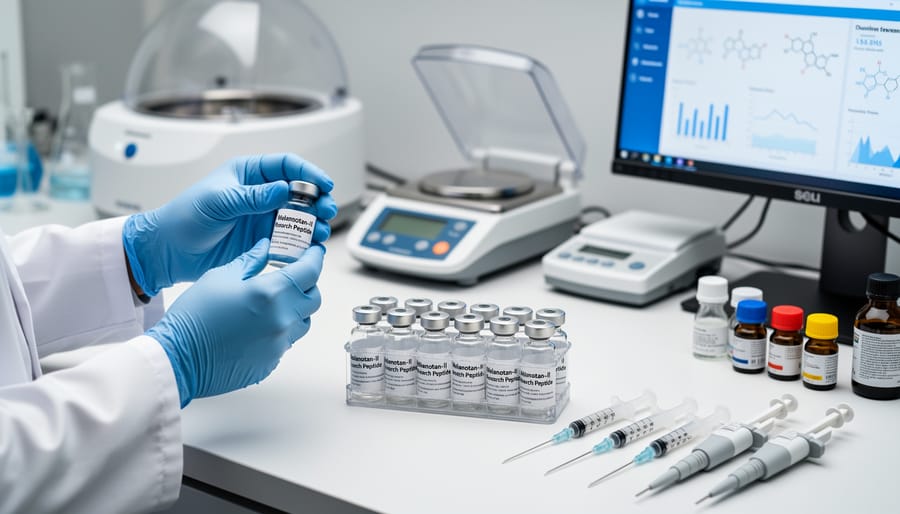
Melanotan-II is a substance created in a laboratory, not found naturally in your body or in nature. Scientists built it by linking together small pieces called amino acids, which connect like beads on a string to form what we call a peptide. Think of peptides as tiny protein chains, much smaller than the proteins you might eat in food.
What makes Melanotan-II interesting is what it does: it can change skin color by triggering the production of melanin, the natural pigment that gives your skin, hair, and eyes their color. When your skin makes more melanin, it becomes darker, similar to what happens when you tan in the sun.
Scientists created Melanotan-II in the 1980s and 1990s while researching ways to protect skin from sun damage. They wanted to see if they could help the body produce a tan without exposure to harmful UV rays. The original idea was to develop something that might reduce skin cancer risk by creating a protective tan before sun exposure.
Researchers designed Melanotan-II to mimic a natural hormone in your body, but they changed its structure to make it work differently and last longer. This lab-made version is stronger and stays active in the body for more time than the natural hormone it copies.
Today, scientists continue studying Melanotan-II to understand how it works, what effects it has, and what its structure tells us about peptides in general.
Understanding Peptides: The Building Blocks
To understand Melanotan-II, we first need to know what peptides are. Think of peptides as short chains, similar to how a necklace is made from individual beads strung together.
Peptides are made from smaller building blocks called amino acids. Your body uses 20 different types of amino acids, which combine in various ways to create different peptides and proteins. It’s like having 20 different colored beads that you can arrange in countless patterns to make unique necklaces.
When just a few amino acids link together, we call it a peptide. When many more connect in longer chains, it becomes a protein. The difference is mainly about length. A peptide might have 2 to 50 amino acids, while proteins contain hundreds or thousands.
Here’s a simple comparison: if amino acids are letters, then peptides are words, and proteins are complete sentences or paragraphs.
Your body naturally makes thousands of different peptides. They act as messengers, sending signals between cells. Some tell your body when you’re hungry. Others help wounds heal or regulate your sleep.
Scientists can also create peptides in laboratories. They carefully connect specific amino acids in exact orders to make peptides that don’t exist in nature. Melanotan-II is one of these lab-made peptides, designed with seven specific amino acids arranged in a particular pattern.
Understanding this basic structure helps explain how Melanotan-II works and why its specific design matters.
The Structure of Melanotan-II

The Circular Design
Think of Melanotan-II as a bracelet instead of a necklace. While many peptides form straight chains, Melanotan-II connects its ends together to create a ring. This circular design isn’t just interesting to look at, it makes a big difference in how the peptide works.
When a peptide forms a circle, it becomes much harder to break apart. Imagine trying to snap a rubber band versus cutting a loose string. The body has natural scissors (called enzymes) that cut up peptides, but circular shapes protect against these scissors. This means Melanotan-II stays intact longer in your system.
The ring shape also helps Melanotan-II keep its form. Straight-chain peptides can flop around and change shape, but a circle stays more consistent. This stability is important because Melanotan-II needs to fit precisely into certain body receptors to work properly. A stable shape means it can do its job more reliably.
Scientists call this circular structure a “cyclic peptide.” The ring formation happens when specific parts of the chain bond together, locking the shape in place. This design feature is one reason researchers find Melanotan-II particularly interesting to study.
The Seven Building Blocks
Think of Melanotan-II as a bracelet made of seven different beads. Each bead is an amino acid, and together they form the complete peptide. These seven pieces snap together in a specific order, which determines how Melanotan-II works.
The amino acids have scientific names, but what matters more is understanding that each one plays a role. Some help the circle stay closed. Others help Melanotan-II recognize and bind to receptors in your body. One particular piece helps trigger the tanning response.
Scientists know the exact sequence of these seven building blocks. This precise arrangement is why Melanotan-II can affect skin pigment. Change even one piece, and the peptide might not work the same way or might not work at all.
How Melanotan-II Properties Work

Melanotan-II works in your body through a series of specific actions that scientists can measure and observe. Understanding these properties helps explain why researchers find this peptide interesting and how it produces its effects.
The most important property of Melanotan-II is how it interacts with certain receptors in your body. Think of receptors as locks on the outside of your cells, and Melanotan-II as a key that fits into those locks. When the key turns in the lock, it triggers a response inside the cell. Melanotan-II fits into receptors called melanocortin receptors, which are found in skin cells and other tissues throughout your body. When it connects to these receptors, it sends signals that tell the cells to start making more pigment.
Before we go further, here are some key terms that help explain how Melanotan-II works:
- Receptor
- A special spot on the outside of a cell that receives chemical signals, like a lock waiting for the right key.
- Melanin
- The natural pigment or color in your skin, hair, and eyes that protects you from sun damage and determines your coloring.
- Synthetic Peptide
- A small protein chain made in a laboratory rather than produced naturally by living organisms.
Once Melanotan-II activates these receptors, your skin cells respond by producing more melanin. This is the pigment that gives your skin its color and provides some protection from sunlight. The peptide essentially tricks your body into behaving as if it has been exposed to the sun, causing skin to darken without actual sun exposure.
Another important property is how long Melanotan-II stays active in your body. Because of its circular structure, it breaks down more slowly than many other peptides. This means it can continue working for several hours after entering your system. Scientists measure this as its half-life, which is the time it takes for half of the substance to be processed and removed by your body.
Melanotan-II also binds strongly to its receptors, meaning it holds on tightly once it connects. This strong binding contributes to its lasting effects and explains why small amounts can produce noticeable changes in skin pigmentation.
Why Scientists Study Melanotan-II
Scientists study Melanotan-II because it helps them understand how the human body works, especially how skin color develops and changes. By examining this peptide, researchers learn about the signals our bodies use to control different functions.
One reason scientists find Melanotan-II interesting is that it mimics a natural hormone our bodies already make. This makes it a useful tool for studying how our skin responds to signals from the brain. When researchers understand how Melanotan-II connects with receptors in skin cells, they learn more about the body’s own systems.
Scientists also study Melanotan-II to explore how small changes in a peptide’s structure affect what it does. Remember that circular shape we discussed? Researchers want to know exactly how that design helps the peptide stay stable and work effectively. This knowledge helps them understand other peptides too.
Another area of interest is how long Melanotan-II stays active in the body compared to natural hormones. Scientists measure this to learn about peptide stability and breakdown. These details matter because they reveal how our bodies process different molecules.
Understanding Melanotan-II’s properties also teaches scientists about receptor systems throughout the body. The same type of receptors that respond to this peptide control other functions beyond skin color, so studying one peptide can unlock information about multiple body systems.
This research is about building scientific knowledge and understanding the amazing chemistry happening inside us every day.
Common Questions About Melanotan-II
Is Melanotan-II a natural substance?
No, Melanotan-II is not found in nature. Scientists created it in laboratories by modifying a natural hormone that humans already produce, but the final peptide itself is entirely synthetic.
How is Melanotan-II different from other peptides?
Its circular ring structure sets it apart from most peptides, which are straight chains. This ring shape makes Melanotan-II more stable and longer-lasting in the body than many similar compounds.
Why does the structure of Melanotan-II matter?
The structure determines how the peptide works. Its specific shape allows it to fit into receptors in skin cells, triggering the color-changing response. Without this exact structure, it wouldn’t function the same way.
Can I see or touch Melanotan-II?
The peptide itself is far too small to see without powerful laboratory equipment. In research settings, it typically appears as a white powder that scientists dissolve in liquid for study.
These questions come up often when adult learners first encounter scientific topics. Understanding basic properties helps you build confidence with science concepts and develop skills for evaluating sources when you read health or science information online.
Learning about peptide structures can feel challenging at first, but breaking down complex topics into smaller pieces is exactly how effective education works. Many free Canadian resources support adult learning in science and health literacy, giving you tools to explore topics that interest you at your own pace.
Remember that knowing what something is made of and how it’s built helps you understand what it does. The circular structure, the seven connected amino acids, and the way Melanotan-II interacts with receptors all work together as a system. Each property connects to the others, creating a complete picture of how this synthetic peptide functions.
You’ve now explored the basic properties and structure of Melanotan-II, a synthetic peptide made of seven amino acids arranged in a circular shape. You learned how this ring design helps it stay stable in the body, how it works by binding to specific receptors like a key in a lock, and why scientists find its unique structure interesting for research.
Understanding scientific concepts like peptide structure builds your confidence with complex topics. Science isn’t just for experts. Adult learners bring valuable life experience that helps make sense of new information. Each topic you explore strengthens your knowledge base.
If you’re interested in learning more about science, health, or other subjects, free resources are available across Canada. Many public libraries offer adult learning programs, online courses, and tutoring support at no cost. Community colleges and literacy organizations provide accessible science materials designed specifically for adult learners. Your curiosity is a powerful tool for lifelong learning.
Keep asking questions, keep exploring, and remember that learning happens at every age. The more you understand about how things work, the more empowered you become to make informed decisions about your health and well-being.