

Evolutionary psychology is the study of how human thoughts, feelings, and behaviours developed over thousands of years to help our ancestors survive and reproduce. This field explains why we act the way we do today by looking at the challenges early humans faced, like finding food, staying safe, and forming relationships. Understanding evolutionary psychology can help you make sense of everyday behaviours, from why we crave sweet foods to why we form close friendships.
This article will explain what evolutionary psychology is, how it works, and how it applies to daily life. You’ll learn about the main ideas in this field without needing a science background. The concepts are useful for teachers, adult learners, and anyone curious about human nature. All the information here is free to use and includes examples that connect to Canadian life and culture.
Evolutionary psychology isn’t about claiming that everything we do is controlled by our genes. It’s about recognizing patterns in human behaviour that have roots in our shared past. These patterns show up across different cultures and time periods, giving us clues about what makes us human. By the end of this article, you’ll have a clear picture of how our ancestors’ experiences still influence the way we think and act in 2026.
What Evolutionary Psychology Means
Evolutionary psychology is the study of how our minds and behaviors developed over thousands of years to help humans survive and thrive. Instead of just asking “how do people act?”, this field asks “why did humans develop this way?” It looks at the connection between our ancient past and how we think and feel today.
Think about common human reactions. Many people feel scared when they see a snake, even if it’s harmless or behind glass. Most of us crave sweet foods like fruit or dessert. These aren’t random, they’re patterns that helped our ancestors stay alive. People who avoided snakes were less likely to get bitten. People who sought out sweet foods found energy-rich fruit that kept them strong. Over many generations, these helpful reactions became part of how human brains work.
- Evolution
- The process of living things changing slowly over many generations to better fit their environment.
- Adaptation
- A trait or behavior that helps a living thing survive and pass on genes to the next generation.
- Natural Selection
- The process where traits that help survival become more common because individuals with those traits live longer and have more children.
- Ancestors
- The people who came before us, including parents, grandparents, and humans from thousands of years ago.
- Survival Traits
- Characteristics or behaviors that helped early humans stay alive, find food, and raise families successfully.
Evolutionary psychology helps us understand that many of our thoughts, emotions, and reactions today are not flaws or mysteries. They’re tools that once helped humans survive in a very different world. Learning about these patterns gives us insight into why we are the way we are.
How Evolutionary Psychology Works
Looking at Our Ancestors’ Problems
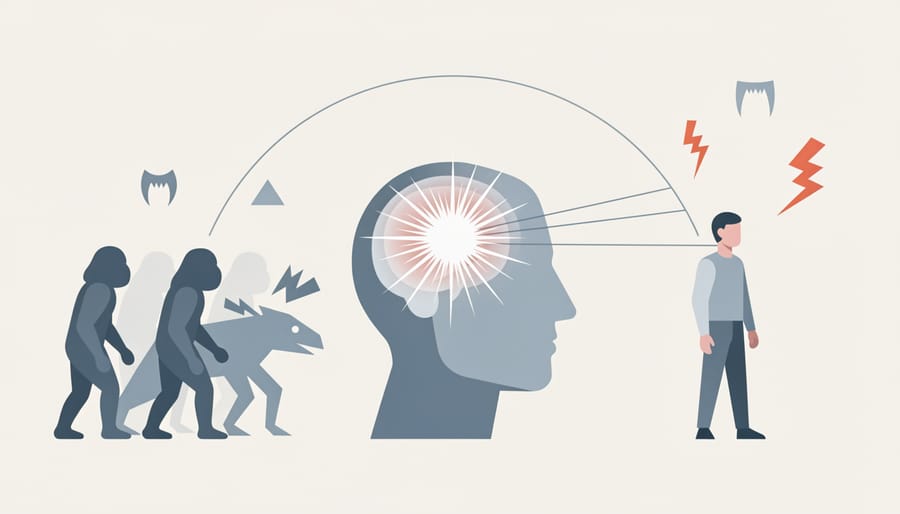
Evolutionary psychologists work like detectives looking at clues from the past. They study the daily problems early humans had to solve to stay alive. These problems included finding enough food to eat, staying safe from predators and other dangers, and raising children who would survive to adulthood. Each challenge shaped how human brains work today.
Researchers look at fossils, ancient tools, and how hunter-gatherer groups lived to understand what our ancestors faced. For example, early humans who quickly recognized dangerous animals survived longer than those who didn’t. People who worked together to find food did better than those who tried alone. Parents who protected and taught their children helped pass on successful behaviors.
These survival challenges happened over thousands of generations. The people whose brains solved these problems best had more children, passing on those helpful thinking patterns. This means the way you think today connects directly to what kept your ancestors alive long ago.
Connecting Past to Present
Our brains still run on software designed for a world that no longer exists. The cravings, fears, and reactions you experience every day aren’t random, they’re survival tools passed down from ancestors who lived thousands of years ago.
Think about why a donut feels irresistible even when you’re not hungry. Early humans rarely found sweet or fatty foods, so bodies that craved these high-energy treats had better survival chances. Your brain rewards you with pleasure when you eat sugar or fat because that response kept your ancestors alive during food shortages. Today, with grocery stores on every corner, that same urge can work against you.
The same pattern shows up in social situations. If you feel uncomfortable in a crowded room or anxious when meeting strangers, you’re experiencing an old alarm system. For early humans, unknown people could mean danger, and large groups increased the risk of conflict or disease. Your racing heart in a packed bus isn’t a flaw, it’s an ancient warning signal doing its job in the wrong setting.
Even your sleep patterns connect to the past. Waking up alert at small noises made sense when predators hunted at night. Your tendency to worry about what others think helped ancestors stay accepted in their group, which meant safety and shared resources.
Understanding these connections doesn’t make the feelings disappear, but it helps you recognize why your mind reacts the way it does.
Different Areas of Evolutionary Psychology
Emotions and Feelings
Our ancestors faced real dangers every day. A rustle in the grass could be a snake. A stranger’s angry face might mean a fight. When early humans felt fear, their bodies prepared to run or hide. This quick emotional response kept them alive long enough to have children and pass on their genes.
Today, we still have these same powerful emotions, even when we are safe. You might feel your heart race when you see a spider, even though it cannot hurt you. You might feel joy when spending time with friends because humans who enjoyed being together formed stronger groups. Anger helped our ancestors defend themselves and their families when threatened.
These emotions are not problems. They are tools our brains developed over thousands of years. Understanding this can help us make sense of our feelings and respond to them in healthy ways that fit our modern lives.
Relationships and Family

Humans evolved to form deep, lasting relationships because groups survived better than individuals. Our ancestors who built strong family bonds, chose reliable partners, and cared for their children passed these traits down to us. Today we still feel drawn to connection, wanting close friendships, romantic partners, and caring for family members.
Choosing a partner isn’t random. Evolutionary psychology shows we look for traits that signaled health and good parenting skills in our ancestors: kindness, reliability, and the ability to provide and protect. These preferences helped ensure children would grow up safe.
Parenting behaviors also have evolutionary roots. Parents naturally protect, teach, and nurture their children because those who did raised healthier offspring. This connection between learning at home and a child’s development is why family literacy matters so much today, reading together and teaching language skills taps into our evolved drive to prepare the next generation for success.
Social Life and Groups

Early humans who stayed together in groups had a much better chance of surviving than those who tried to live alone. Groups could hunt larger animals, protect each other from predators, and care for sick or injured members. This history shaped our brains to naturally want to belong, cooperate, and help others in our community.
Today, we still feel these same pulls. We want friends, we join clubs or teams, and we feel good when we help our neighbors. We share food at potlucks, work together on projects, and feel upset when someone in our group is left out. These aren’t just nice behaviors, they’re built into how our minds work because cooperation helped our ancestors stay alive and raise healthy children.
Making Choices and Solving Problems
Our ancestors didn’t have time to think through every choice. When they heard a rustle in the grass, they had to decide instantly: run or stay? Those who stopped to think carefully often didn’t survive. The ones who acted fast passed their quick-thinking brains down to us.
This is why we make snap judgments. Your brain uses mental shortcuts to decide things without working through every detail. You might feel uneasy about a stranger without knowing why, or choose the familiar path over an unknown one. These instant reactions once saved lives.
These shortcuts still help us today. You pull your hand from a hot stove before you think about it. You sense danger and move away from a dark alley. But sometimes these fast decisions don’t fit modern life. Your brain might panic about public speaking the same way it would about a real threat, because it can’t always tell the difference.
Understanding these patterns helps you make better choices. When you feel anxious about something safe, you can remind yourself that your brain is using an old survival tool that doesn’t match the current situation.
How Evolutionary Psychology Is Used Today
Learning and Education
Evolutionary psychology shows us that humans evolved to learn through stories, repetition, and hands-on practice, methods that still work best today. Understanding how your brain learns helps adult literacy programs build on natural strengths rather than fight against them. Our ancestors learned by watching others, trying skills themselves, and getting immediate feedback on what worked. Modern educators use these same principles when they choose instructional methods that include real-life examples, group discussion, and practice with relevant materials. Adult learners often succeed when lessons connect to their daily experiences, paying bills, reading prescriptions, helping children with homework, because our brains evolved to prioritize learning that solves real problems. Programs that respect how we naturally absorb information, through small steps and meaningful context, work with our evolved learning systems instead of against them.
Health and Well-being
Our bodies and minds developed to handle the challenges our ancestors faced, not the world we live in today. This mismatch explains why many of us feel stressed or anxious in modern life. Our ancestors needed stress responses to run from danger or fight threats. Today, that same system activates when we face deadlines, crowded buses, or money worries, situations that aren’t life-threatening but feel urgent to our evolved brains.
Understanding this helps us take better care of ourselves. When we recognize that anxiety is our body’s old alarm system working overtime, we can find ways to calm it. Regular movement, time in nature, and strong friendships address needs our bodies evolved to have. Poor sleep, isolation, and constant indoor time work against what our minds and bodies expect. Recognizing these evolutionary needs doesn’t solve every health problem, but it gives us a starting point for making choices that support our well-being in a world our ancestors never imagined.
Research in Canada
Canada is home to active research in evolutionary science and psychology. Universities across the country study how human behavior developed over time, and Canadian researchers share their findings at conferences and through public programs.
In September 2026, Quebec City hosted the International Conference on Microbial Evolution and Genetics, bringing together scientists studying how living things change and adapt. While this conference focused on microbes rather than human psychology directly, it shows how Canadian cities support evolutionary research and create spaces for scientists to share ideas.
More Canadian universities now offer courses in evolutionary psychology, and literacy programs increasingly include materials explaining how our minds developed. Public libraries and community centers provide free access to books and online resources about human evolution, making this knowledge available to everyone interested in understanding why we think and act the way we do.
Common Questions About Evolutionary Psychology
Does evolutionary psychology mean we’re stuck with old patterns and can’t change our behavior? Not at all. Understanding that certain behaviors have evolutionary roots doesn’t mean we’re prisoners of our past. Our brains are flexible and we can learn new ways of thinking and acting. Evolutionary psychology simply helps explain why some habits or reactions feel natural or automatic, but we still have the power to make conscious choices and develop new skills throughout our lives.
Does this mean we can’t change our behavior?
No. Understanding evolutionary influences shows why some patterns feel natural, but humans are highly adaptable and capable of learning and changing throughout life.
Is evolutionary psychology proven?
Like all science, evolutionary psychology uses evidence and testing to support its ideas. Researchers continue to study and refine theories as we learn more about human behavior and our past.
How does this help me in daily life?
It can help you understand why you react certain ways to stress, food, relationships, or social situations. This awareness can guide healthier choices and reduce self-judgment.
Where can I learn more about evolutionary psychology?
Many free online resources, public libraries, and literacy organizations offer accessible materials. Canadian universities and research groups also provide learning opportunities for adult learners.
Many people wonder how evolutionary psychology relates to other ways of studying human behavior. While evolutionary psychology focuses on how our past shaped our minds, personality psychology looks at individual differences between people today. Both fields help us understand ourselves better, just from different angles. Learning about evolution can actually make other psychology topics easier to understand because it provides context for why humans developed such varied personalities and behaviors.
Free resources are increasingly available across Canada. Public libraries carry books on evolutionary psychology written for general readers. Adult learning centers often include basic psychology in their programs. Online platforms offer free introductory courses that explain concepts in plain language. You don’t need a university degree to learn about how your mind works and why we all share certain human tendencies that connect us to our ancestors.
Evolutionary psychology opens a window into understanding ourselves by showing us where our thoughts and behaviors came from. When we learn that our brains evolved to solve problems our ancestors faced thousands of years ago, everyday reactions start to make sense. The anxiety you feel before speaking in public or the comfort you find in close friendships aren’t random. They’re part of our human story.
Understanding this shared past doesn’t just satisfy curiosity. It gives you tools to work with your natural tendencies instead of against them. You can recognize why certain situations feel hard and find practical ways to manage them. This knowledge helps in parenting, learning, relationships, and daily decision-making.
Learning more about evolutionary psychology is easier than ever, especially in Canada. Many literacy organizations offer free resources designed for adult learners. Public libraries stock accessible books on human behavior and evolution. Online platforms provide straightforward articles and videos that explain these ideas without academic jargon. The more you explore how we became who we are, the better equipped you’ll be to make choices that work with your evolved mind rather than fighting it.